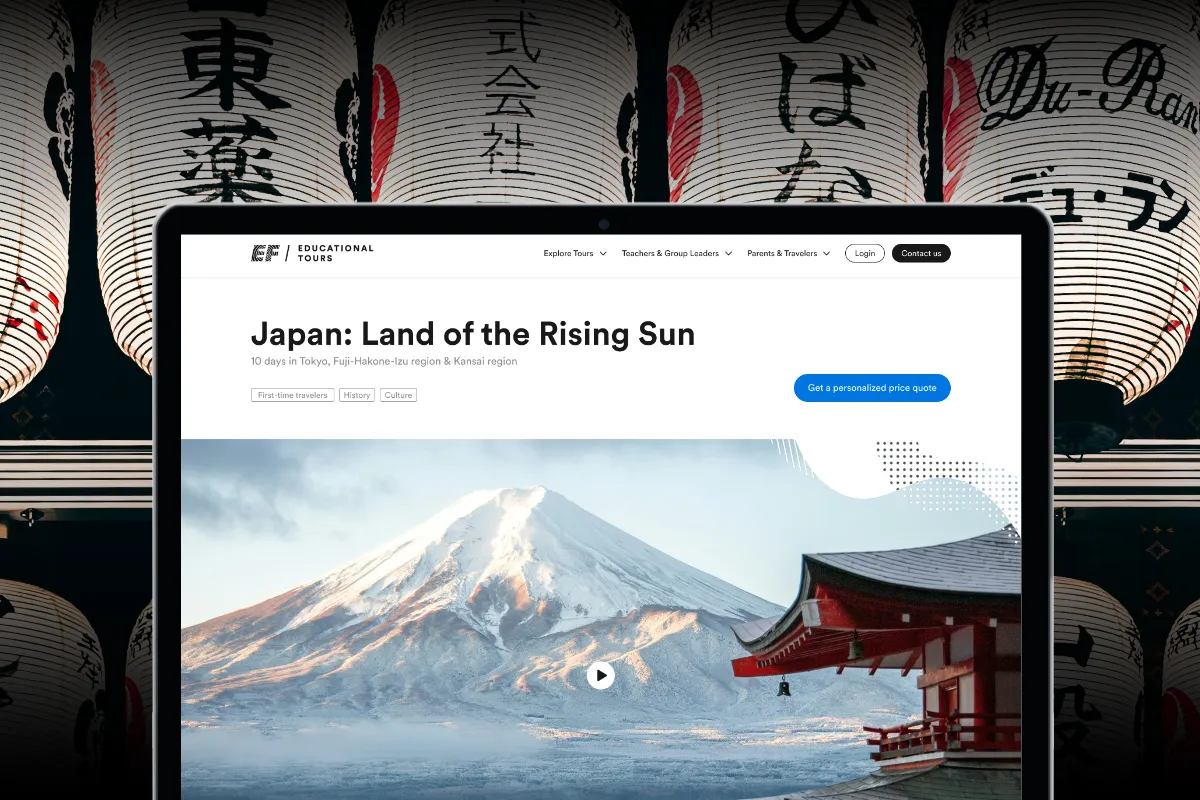
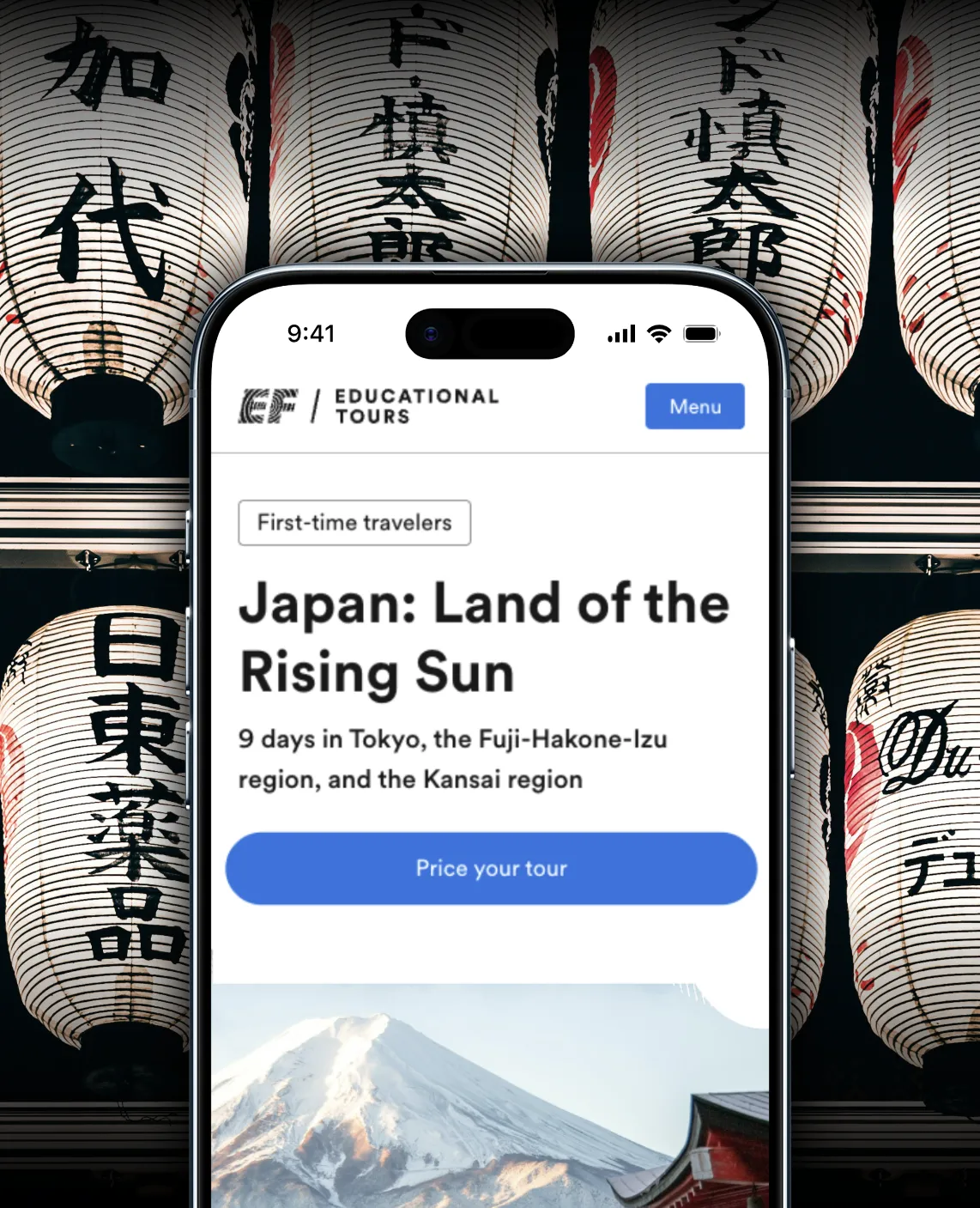
EF Product pages
At EF, teachers aren’t just buying a trip, they’re making a high-stakes decision on behalf of their students, their school, and themselves. Our challenge wasn’t to just redesign a product page. It was to re-architect how an institution earns trust, communicates educational value, and builds confidence at the moment of choice.
As Creative Director, I led the transformation of EF’s tour pages from a fragmented template into a decision-driven product experience — balancing aspiration with accountability, and story with proof.
Role
Focus
How we defined success
We deliberately avoided treating this as a pure conversion exercise (though we were aiming to grow new teachers by 18% year-over-year and increase conversion rates from 0.8% to 1.5%). We defined success across three layers of impact:
First, behavioral:
Would more teachers meaningfully progress into planning, rather than skim and leave?
Second, cognitive:
Would teachers understand the full shape of the experience earlier, with fewer late-stage surprises?
Third, emotional:
Would teachers feel excited by this experience?
Would teachers feel empowered to act and not just pressured to convert?

Personas as decision frameworks
We did not treat personas as demographic segments or marketing profiles. We treated them as decision frameworks, models of how different teachers evaluate risk, value, and readiness at the moment of commitment.
The purpose of these personas was not personalization. It was prioritization.
When we faced design tradeoffs — what to surface first, what to defer, what to simplify, what to make explicit — these two decision patterns anchored the work.

Primary persona: Adventurous Ari
Ari arrives inclined to say yes. She's inspired by purpose and impact, but hesitates later when she begins to imagine the consequences of committing. Her core tension is not desire. It is the fear of making a poorly defended decision. For Ari, the design problem was late-stage reassurance.
This led us to:
Let story and destination lead early.
Delay operational detail until motivation was activated.
Make itinerary, inclusions, and learning outcomes most legible when her questions shifted from why to how.
Goal:
Let her feel inspired first — then remove every reason she might talk herself out of acting.

Secondary persona: Analyzer Ellen
Ellen arrives skeptical by default. She leads with accountability and will not allow herself to feel inspired until the experience is defensible. Her core tension is not fear of commitment. It is the fear of being irresponsible. For Ellen, the design problem was early credibility.
This led us to:
Surface the itinerary early and make it the structural backbone.
Pair inclusions directly with price and benefits.
Elevate standards and learning outcomes into the core narrative.
Avoid vague or purely emotional claims.
Goal:
Let her trust the system first — then give her permission to feel inspired.
Strategy and plan
Our persona research revealed something critical: sequencing mattered. We weren't just designing components, we were designing a decision journey that matched how different teachers actually think through high-stakes commitments. Purpose-driven teachers needed to feel inspired before we hit them with logistics. Risk-averse teachers needed proof points up front before we asked them to trust us.
That shift reframed the entire page. It wasn't a product description anymore, it was a tool that helped teachers decide. The three phases that followed were built to test that thinking: first by aligning on the vision, then by stress-testing it against real constraints, and finally by proving it could work at scale.
PHASE 1
Strategy and design exploration
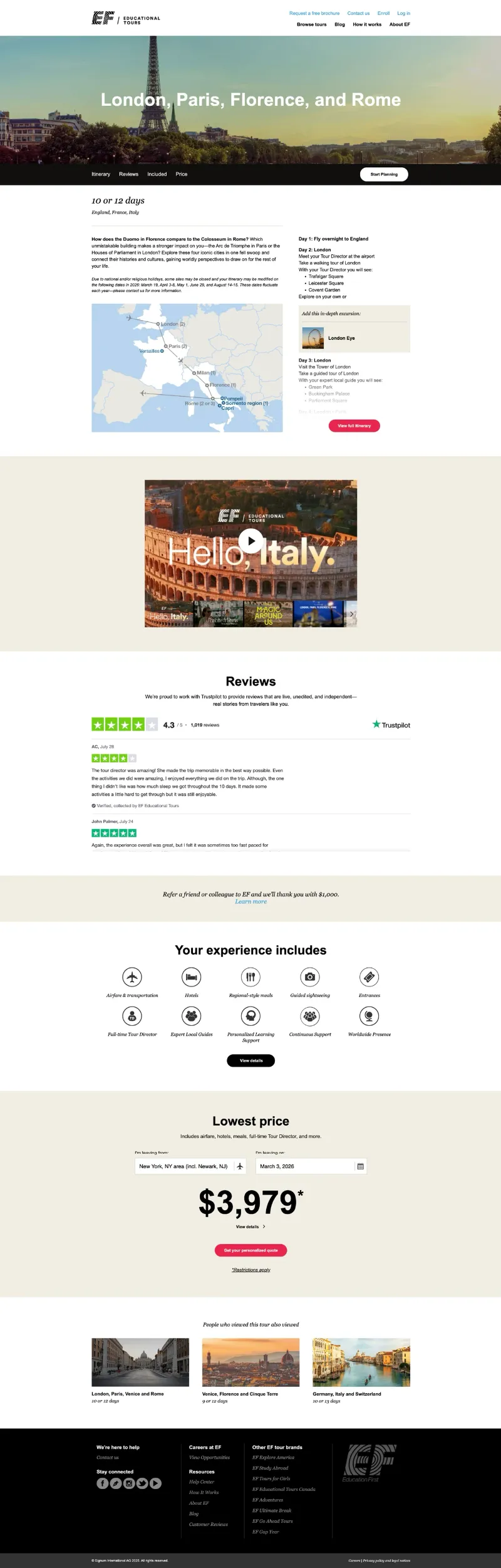
We started by creating high-fidelity desktop designs—not as something to ship, but as a way to get everyone on the same page. We needed senior leadership to see where this product could go, especially since people would be using it to make really important decisions.
What we were after:
A vision for where this could go long-term, not just a quick facelift
A way to make the experience feel both inspiring and trustworthy at the same time
Different ways to organize itineraries, frame pricing, and guide people through their decisions
This phase gave us the principles and logic that would guide everything that came after.
PHASE 2
Mobile adaptation and behavioral validation
Once leadership was aligned, we translated everything to mobile and got it ready for usability testing. This wasn't just about making things responsive—it was about making sure the experience still worked when space and attention were limited.
Our goals were to:
Make it easy to scan and find the important actions quickly
Help people discover itinerary details earlier
Keep the right emotional tone while optimizing for smaller screens
Adapt the designs so we could test them with real users
PHASE 3
Iterate, launch, and scale
After refining the designs based on testing feedback, we rolled out the new experience on five tour pages first. We wanted to validate that it actually worked before expanding to the full portfolio of 400+ tours.
Goals for the rollout:
Measure impact on leads and engagement, not just conversions
See how real users actually navigated the experience
Make sure the system could scale across different destinations, prices, and tour types
Monitor and iterate on both design and content
Phase 1
Strategy and design exploration
To align stakeholders and stress-test our strategy, we developed three distinct desktop prototypes—each one exploring a different theory of how emotion, clarity, and sequencing could shape decision-making and drive conversion.
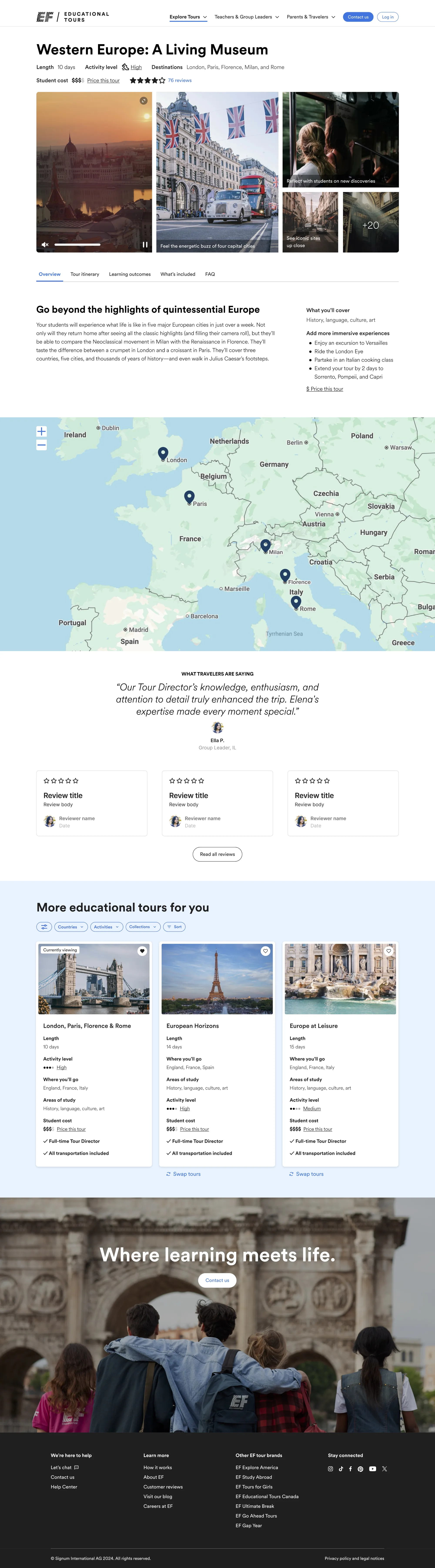
The Mosaic concept
Mosaic was built around a simple idea: let teachers enter the experience however they want, without forcing them down one prescribed path. We intentionally used existing assets and code from other EF products to see if we could build something decision-focused without starting from scratch.
This let us test a few things:
Could modular patterns support different decision styles?
Could we increase our velocity by reusing existing code and patterns?
Would familiar components build trust and speed for risk-averse teachers?
Could a modular system work across 250+ tours without breaking?
What we learned
We didn't choose this direction. It was efficient and scalable, but it didn't create enough momentum. Teachers could find information easily, but the experience didn't tell a story. It felt safe, but flat—built for browsing, not believing.
The immersive concept
Immersive was built around one belief: the order you encounter information shapes how you feel about it. Every section was designed to move teachers through a clear arc—from inspiration, to proof, to trust, to commitment.
It wasn't immersive just because of big visuals or fancy interactions. It was immersive because:
We controlled the sequence tightly
We moved learning outcomes earlier in the scroll
We limited early choices so teachers wouldn't get lost or overwhelmed
We introduced story and credibility in a rhythm that built momentum
We balanced dreaming with grounding details
We optimized for confidence, not exploration
What we learned
This direction resonated well with stakeholders—they understood more and the tone felt right. But some sections still felt flat, and the itinerary wasn't getting the attention it deserved. We had the right arc, but not enough texture. The experience moved people forward, but it didn't always hold their attention along the way.


The EDitorial concept
Editorial was built on a different premise: what if we could build confidence through bringing the feeling of being to tour to life?
Instead of controlling the sequence, we leaned into atmosphere and visual storytelling. The idea was to let teachers explore what the trip felt like before getting into logistics or structure.
It wasn't about guiding decisions—it was about creating immersion:
We prioritized discovery over direction
We used imagery and editorial tone to build emotion
We let teachers wander and absorb
We tested how far desire could carry the decision on its own
What we learned
This direction created a strong emotional pull, but it didn't guide teachers clearly enough through a high-stakes choice. Scroll depth was high—people were engaged—but they weren't converting. It made them want to go, but not necessarily know how to decide. The feeling was there, but the framework wasn't.
Phase 2
Mobile adaptation and behavioral validation
Mobile adaptation
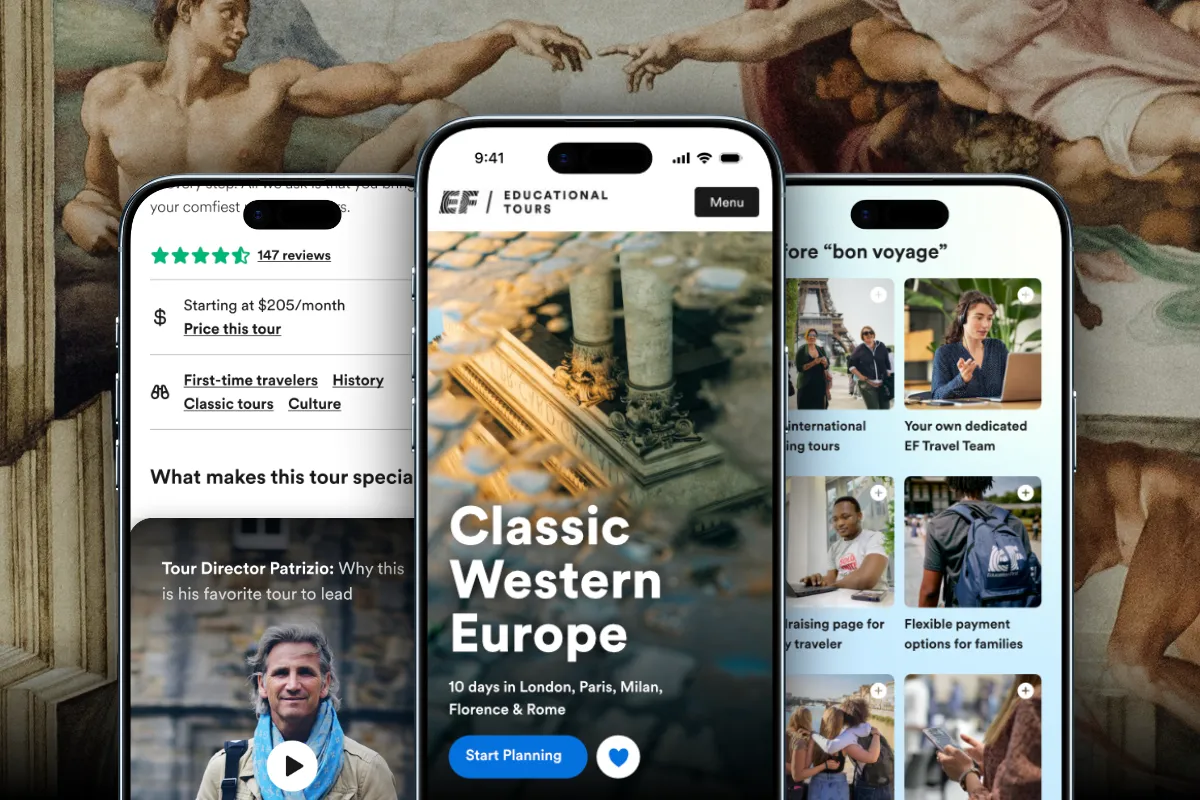
Based on stakeholder feedback and internal user research, we adapted the experience for mobile with a few critical shifts:
We paired the itinerary more closely with the maps and highlights. We paired pricing closer with inclusions to build trust earlier. We reduced large hero images that slowed load times and created cognitive friction. We tightened explanatory copy to maintain momentum without losing clarity. And we made CTAs more visible and added microcopy to explain what happens next, so teachers never felt lost or uncertain about the next step.
The goal was to preserve the emotional arc of the desktop experience while honoring the constraints and behaviors of mobile decision-making.
Testing with users
We put two mobile mobile prototypes in front of 24 teachers through remote, unmoderated sessions—about 30 minutes each, over 500 minutes of recorded feedback on userlytics.
The focus was simple: does this build clarity? Does it earn trust? Does it move people toward action?
We tested comprehension, usefulness, flow and task completion. We needed to know if the structure worked before we made more refinement to the surface. And we mixed teachers who knew EF with those who didn't, to see how the experience performed across different levels of familiarity and skepticism.


What we learned
Itineraries matter most
Teachers expect a full day-by-day breakdown—travel times, meals, accommodations, activities. The interactive map tested well, but felt disconnected from the itinerary itself. We needed to merge them—letting users click through days or filter by activity type so the two work together instead of competing for attention.
Inclusions vs. benefits created confusion
Users couldn't tell the difference. They want to know what's included, who it's for (teachers vs. students), and how it ties to pricing. The solution was to build a clear, structured inclusions section with expandable details and transparent pricing context—so nothing felt hidden or vague.
Educational value needs to be explicit
Teachers want to see curriculum ties, academic credit options, and learning outcomes—not just implied educational value. We explored using badges or icons to surface academic connections, and creating a dedicated section that speaks directly to learning goals instead of burying them in body copy.
Pricing builds or breaks trust
Hidden pricing kills confidence. Teachers want transparency before they reach out. We saw an opportunity to introduce dynamic pricing tools and show cost alongside inclusions—so value is clear upfront and trust isn't conditional on reaching a sales rep.
Phase 3
Iterate, launch, and scale

Launch as MVP, not a finish line
With the core experience validated through testing, we intentionally treated the initial rollout as a Minimal Viable Design, a complete, coherent decision system designed to learn in the real world. We launched the experience on five tour pages as a controlled pilot before expanding across the broader portfolio, allowing us to observe real teacher behavior under real stakes.
Current Impact
Conversion data shows these tours are the top preforming tours in their category
50% Median increase conversion rates on new tour pages
20% increase in scroll depth and higher engagement/click rate throughout the page
30% increase in click-rate
Scratching the surface with AI
We used AI to make this work at scale. With the number of tours and the content needed to support them it would have taken months if not years to complete. So we built an agent that pulled tour highlights automatically, scraping web itineraries, ingesting our brand documents for tone, voice, and educational lens, and pulling in online reviews and NPS data to generate highlights and intro paragraphs. The result is content grounded in real traveler sentiment and aligned with how EF talks about learning.
With 400+ tours to cover, this isn't a nice-to-have. As the team scales content production, we'll build additional agents that will also extract specific reviews, maintain highlights, and pull educational outcomes from itineraries, giving us richer, more purposeful copy across the board. Agents will also start helping us pair the perfect tour for a teacher's school, curriculum, community, price point, and educational outcomes. This wasn't just about shipping a new page. It was about setting up the design, data, and systems we need so the experience can get better over time.

Contributors
Creative Direction: Adam Schwartz
Writing: Maddie Poulin
UX/UI: Amanda Bentley
Marketing Strategy: John Cowan
Web Content Manager: Brian McQueen