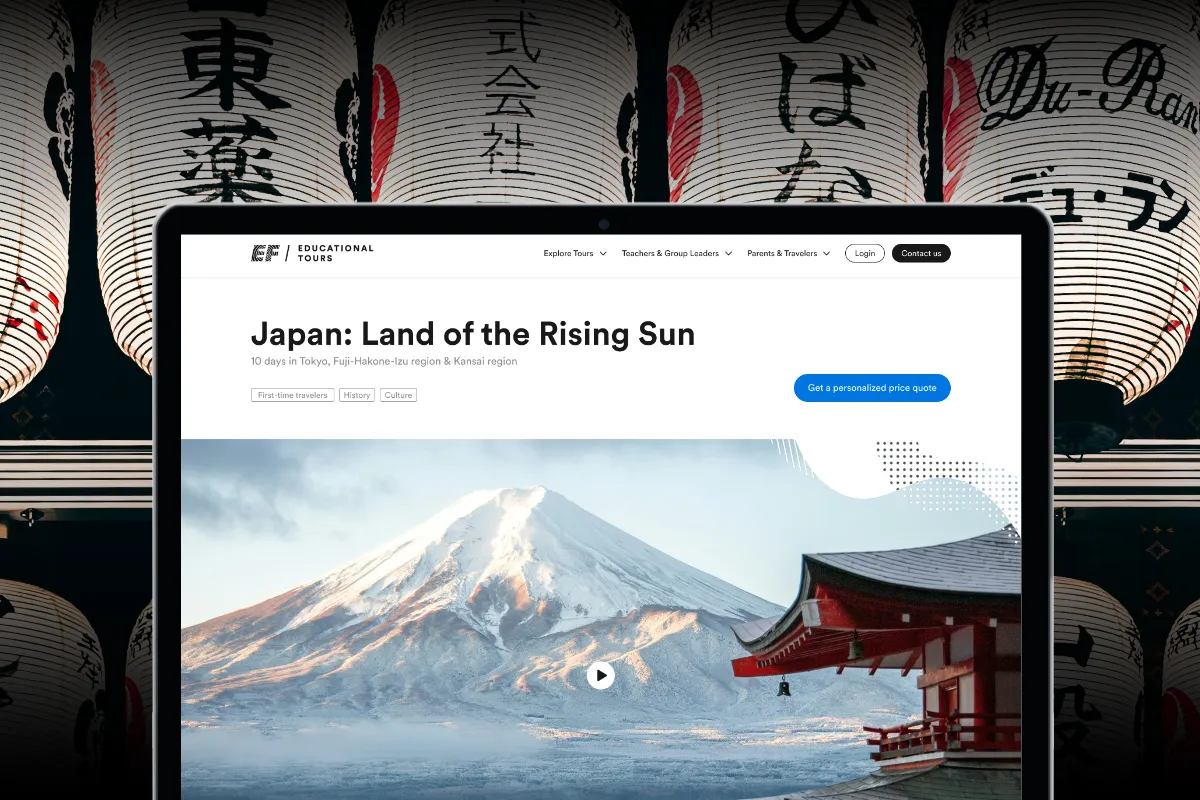
EF Product pages
At EF, teachers aren’t just buying a trip — they’re making a high-stakes decision on behalf of their students, their school, and themselves. Our challenge wasn’t to redesign a product page. It was to re-architect how an institution earns trust, communicates educational value, and builds confidence at the moment of choice.
As Creative Director, I led the transformation of EF’s tour pages from a fragmented template into a decision-driven product experience — balancing aspiration with accountability, and story with proof.
Role
Focus
Teachers weren’t just buying trips — they were making high-stakes decisions on behalf of students, schools, and themselves. Our product pages had become a barrier: they failed to balance emotional inspiration with the institutional accountability teachers needed to defend their choice.
How do you design for inspiration and risk at the same time?
Goals:
18% Growth in new teacher acquisition (YoY target)
1.5% Conversion rate (up from 0.8%)
Top performers in category post-launch
Strategic Approach
Discovery: Two decision mindsets, one experience
Through research with teachers, we identified two distinct decision patterns:
The insight: We weren’t designing for demographics. We were designing for decision states. The same teacher could shift between both mindsets during a single session
The Solution: A sequenced decision architecture. We created a narrative structure that served both mindsets without forcing a single path:
Lead with aspiration — Destination story and educational impact
Build credibility — Detailed itineraries, learning outcomes, transparent inclusions
Remove friction — Clear pricing context, trust signals, obvious next steps
Clarify commitment — Explicit CTAs with microcopy explaining what happens next

Primary persona: Adventurous Ari
Arrives wanting to be inspired, hesitates when imagining consequences
→ Needs: Story-first, then reassurance
Secondary persona: Analyzer Ellen
Arrives skeptical, won’t feel inspired until it’s defensible
→ Needs: Proof-first, then permission to dream
Process
Phase 1: Concept Exploration
We tested three directions to figure out what would actually work:
Mosaic let users explore content in any order—modular, non-linear, choose-your-own-adventure. It was efficient and adaptable, but it never built narrative momentum. People clicked around without committing to anything.
Immersive guided users through a controlled narrative arc. It struck the best balance between engagement and conversion, though some moments in the flow felt slow or predictable.
Editorial led with bold visuals and emotional storytelling—minimal copy, maximum impact. Engagement spiked. Conversion didn't. Gorgeous doesn't always mean effective.
PROCESS
Phase 2: Mobile adaptation and testing
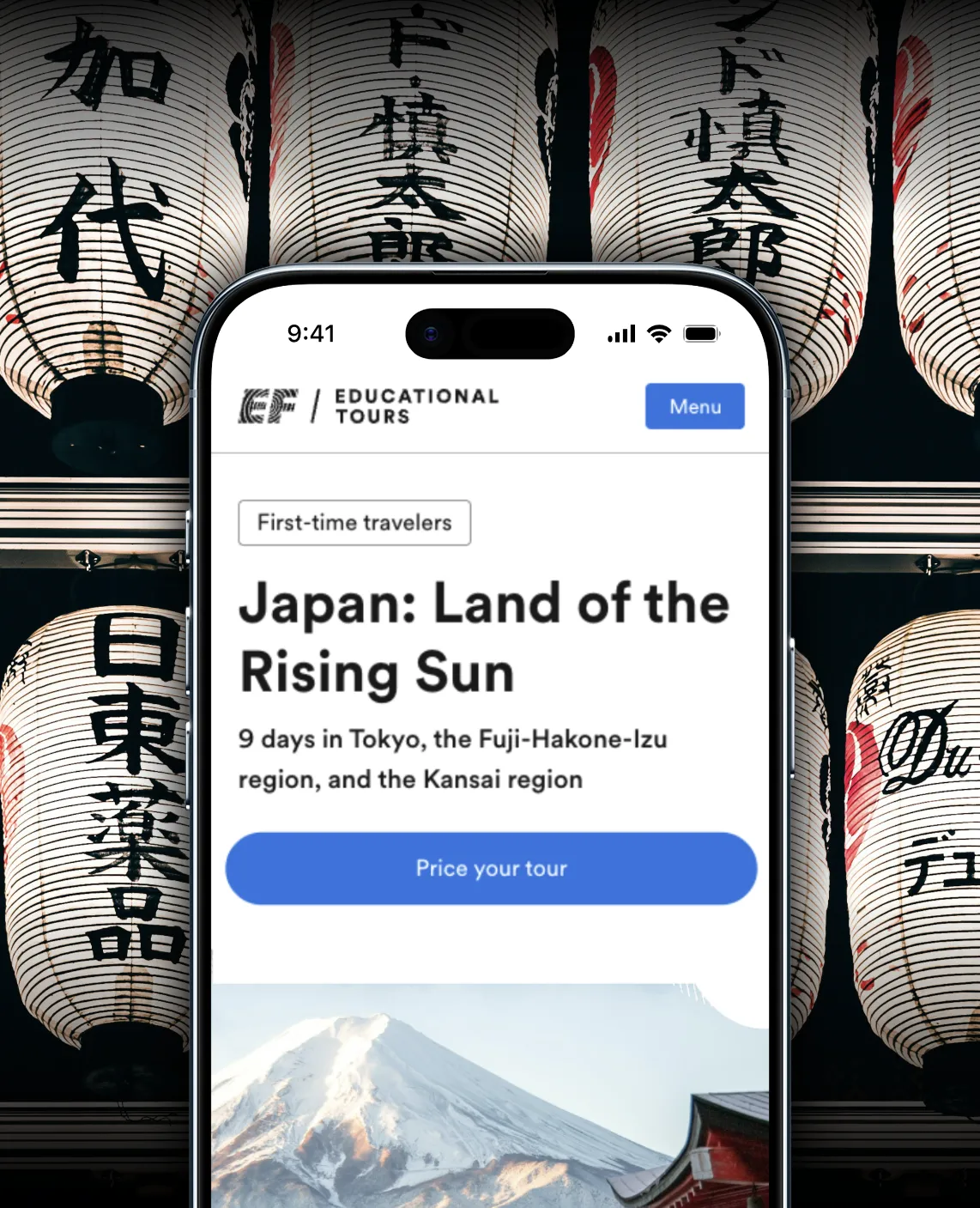
Based on stakeholder feedback and research insights, we adapted the desktop experience for mobile with critical structural shifts: elevated the itinerary for easier access, paired pricing directly with inclusions to build trust earlier, reduced large hero images that slowed load times, tightened copy to maintain momentum, and made CTAs more visible with explanatory microcopy.
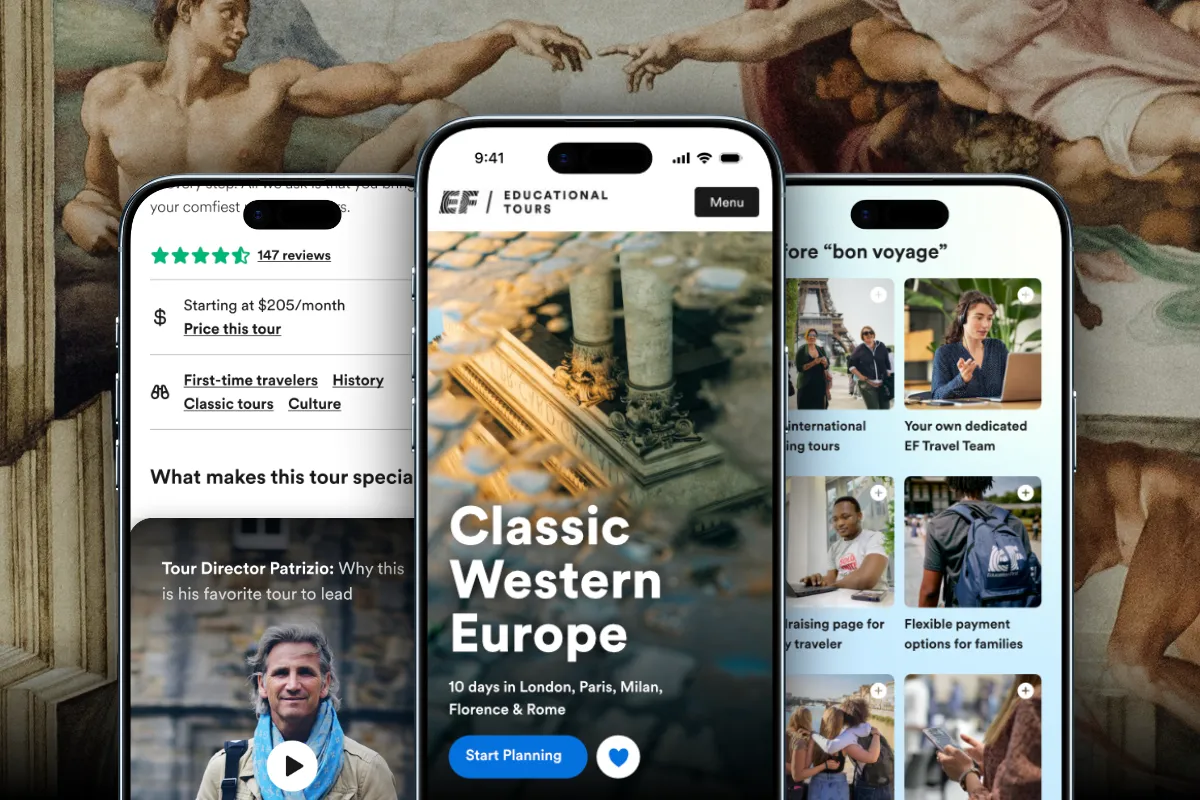
The goal was to preserve the emotional arc while honoring mobile constraints and behaviors. We validated this through 24 remote, unmoderated sessions with teachers (500+ minutes of feedback), mixing EF-familiar and new users to test whether the experience built clarity, earned trust, and moved people toward action—focusing on structural comprehension and flow before visual refinement.
What we learned
Itineraries matter most
Teachers expect a full day-by-day breakdown—travel times, meals, accommodations, activities. The interactive map tested well but felt disconnected from the itinerary. We merged them, letting users click through days or filter by activity type.
Inclusions vs. benefits created confusion
Users couldn't tell the difference. They want to know what's included, who it's for (teachers vs. students), and how it ties to pricing. We built a clear, structured inclusions section with expandable details and transparent pricing context.
Educational value needs to be explicit
Users couldn't tell the difference. They want to know what's included, who it's for (teachers vs. students), and how it ties to pricing. We built a clear, structured inclusions section with expandable details and transparent pricing context.
Pricing builds or breaks trust
Users couldn't tell the difference. They want to know what's included, who it's for (teachers vs. students), and how it ties to pricing. We built a clear, structured inclusions section with expandable details and transparent pricing context.
"Start Planning" felt like a black box
Teachers didn't know what happens after they click, and that uncertainty stalled action. We added microcopy explaining next steps ("We'll reach out within 24 hours"), unified CTA language, and made actions more visible.
—
View the full research report synthesized by my team.
Process
Phase 3: Phased Launch

Launch as MVP, not a finish line
With the core experience validated through testing, we intentionally treated the initial rollout as a Minimal Viable Design—a complete, coherent decision system designed to learn in the real world. We launched the experience on five tour pages as a controlled pilot before expanding across the broader portfolio, allowing us to observe real teacher behavior under real stakes.
This pilot was designed to validate three things:
Whether the experience improved meaningful engagement and progression.
How different decision behaviors actually played out in production.
Whether the system could adapt across destinations, prices, and tour types without losing clarity or trust.
Current Impact
The MVP is already showing promising results. Conversion data shows these tours are either the top or second-best performers in their categories. The new template isn't hurting conversion—if anything, it's holding its own against established pages. We're continuing to track how leads from these pages move through the pipeline to get a fuller picture of impact over time.
Built for now and next
Along with the MVP launch we built a future-state version that shows where this could go. A lot of what we imagined for the future needs deeper work with both content development and engineering—things like new backend logic, more flexible CMS tools, and components that don't exist yet. By splitting it into phases, we could be ambitious without forcing our engineers to build workarounds or one-off hacks.
The future version takes what we learn from the pilot and layers in smarter content strategy and richer storytelling that feels more like the brand EF is becoming—while keeping the core decision-making experience intact.
Together, these two versions turn the tour page into something that can grow. We're launching with a solid foundation, learning from real people, and evolving as both our users and our platform mature. This wasn't just about shipping a new page—it was about setting up the design, data, and systems we need so the experience can get better over time.

Contributors
Creative Direction: Adam Schwartz
Writing: Maddie Poulin
UX/UI: Amanda Bentley
Marketing Strategy: John Cowan
Web Content Manager: Brian McQueen